
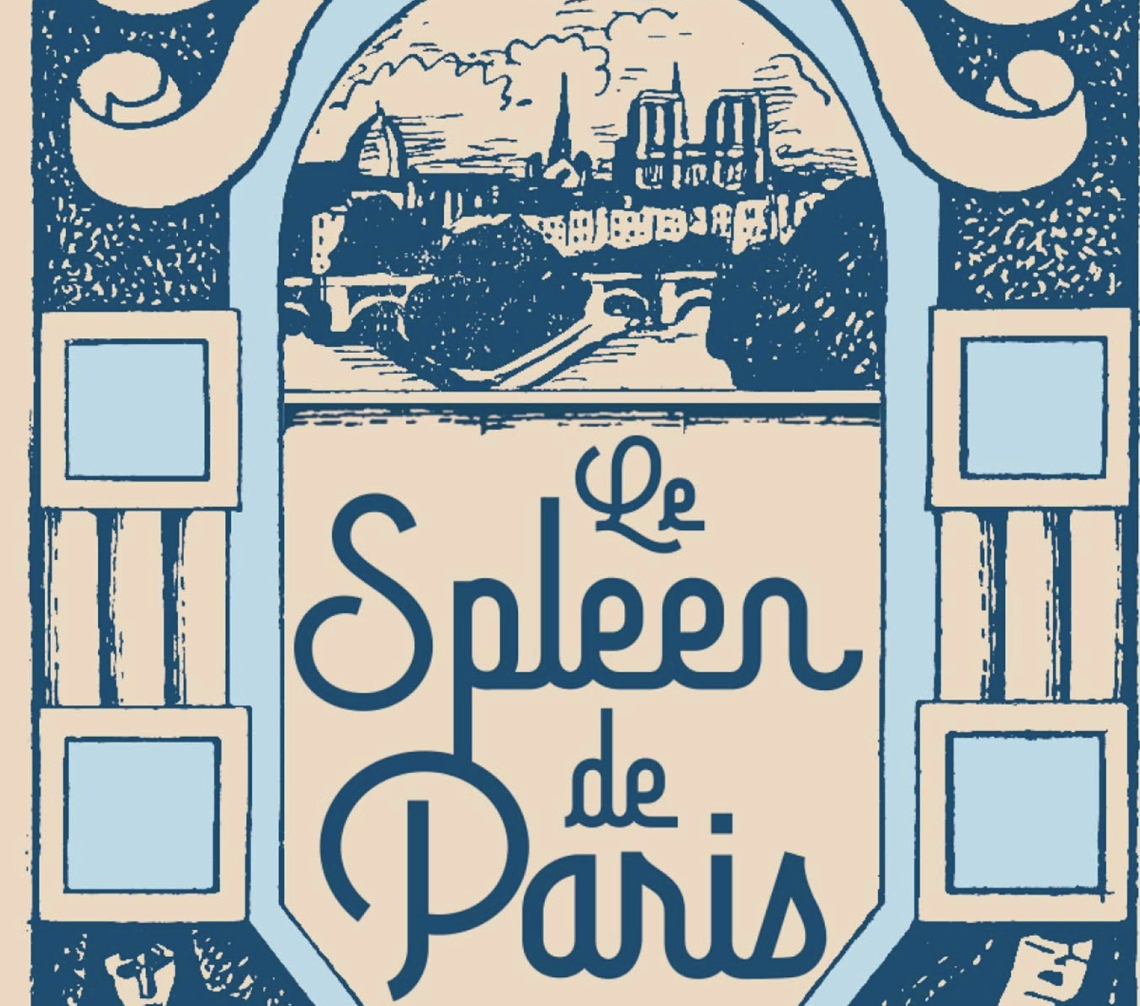
To conclude this first cycle dedicated to the French author Charles Baudelaire, there is Le Spleen de Paris, a work published in 1869 that features Paris as its protagonist, a city in constant transformation: on one hand it presents itself as rich and fascinating, on the other it reveals a deplorable aspect with its anonymous lives, solitary crowds, squalid alleys, smoke-filled cafes, suffocating mists, and gray skies.
The term spleen, as we already saw in the first episode, derives from the English language and literally means spleen, the place where it was believed the cause of depressive syndrome resided, especially in the poet maledict.
The mysteries of a city
The reader is dragged into a Paris they had never known before, but which reveals itself to be surprisingly more alive and more real, so much so that during the reading, it seems to take shape before their eyes. Leaving home, they could see their own city through the disenchanted gaze of the poet, grasping its vices and miseries.
Baudelaire, through the representation of Paris, highlights how the progress brought by capitalism has not only brought benefits but has also triggered a series of negative effects that have struck both society and individuals, victims thus of a system dominated by materialism (hints at this in the first episode).

The poet’s lost halo
The poet is also struck by this change, losing his divine dimension which is expressed through the allegory of his halo, lost in the mud as he was about to cross the Parisian streets. However, this event is not a reason for sadness or regret for him; on the contrary, Baudelaire finds a sense of liberation in it, relieved from the weight of moral responsibility that traditionally weighed upon the poet, once seen as a moral guide for the people.
The fall of the halo thus becomes the symbol of surrender in the face of a world immersed in chaos and confusion. The mud of the city instead becomes a metaphor for the tears of a civilization weeping its own decline, overwhelmed by money and industry at the expense of human well-being and spirituality.
The use of irony in the work
Despite the desolate picture, Baudelaire decides to adopt irony, which thus becomes a powerful tool to ridicule the misery generated by man himself: ”The new flowers of evil, with more freedom, many more details and much more satire.” You can re-listen to Les Fleurs du Mal here
It is precisely through this satire that the poet maledict unmasks the consumerist mentality and materialism of his era:
”I gave up my halo to avoid being run over by a carriage, thus preferring physical salvation at the cost of my dignity”.
By doing so, he has indeed accepted to descend to the level of the common man, becoming a corrupt and vicious being rather than a virtuous one.
False poets
Furthermore, Baudelaire does not hesitate to ridicule his contemporaries, those poets who still consider themselves prophets, without realizing that their role is now void of meaning in a modern society. In a world that lives exclusively in the present, without any consideration for the past or the future, it is no longer possible to stand as a moral guide or make predictions. The only choice left seems to be to abandon oneself to the ephemeral pleasures of earthly life or to fleeting and superficial encounters with one’s fellow beings. I conclude with the poetry that celebrates this sense of intoxication: Get drunk.
Get drunk
One must always be drunk.
Everything lies in this: it is the only problem.
To not feel the horrible burden of time.
Of the time that breaks your shoulders
and bends you toward the earth,
you must get drunk without respite.
But of what? Of wine, of poetry or of virtue,
at your pleasure. But get drunk.
And if sometimes on the steps of a palace,
on the green grass of a ditch,
in the mournful solitude of your room,
you wake up with the drunkenness already diminished or gone,
ask the wind, the wave, the star, the bird, the clock,
everything that flees, everything that groans,
everything that rotates, everything that sings,
everything that speaks, ask what hour it is;
and the wind, the wave, the star, the bird, the clock will answer you
“It is time to get drunk!
To not be the martyred slaves of time, get drunk;
Get drunk without stopping!
Of wine, of poetry or of virtue, at your pleasure.
Paris, the city of love and torment
Baudelaire concludes the work with a hymn of love to his Paris:
”Whether you sleep still in the draperies of the morning, heavy, dark, cooled, or whether you parade in the veils of the evening adorned with gold… I love you, oh infamous capital!”
Reading Le Spleen de Paris is therefore not only a journey into the capital during Baudelaire’s years, but also a deep immersion into human nature, an experience that the frantic and chaotic life of the Parisian flâneur often prevents us from truly living.

Follow AM 1575 News on Facebook for the daily bulletin from France, the Riviera and Monaco.
Fonte: Francia24 – Radio Nizza
