
From November 13 to December 14, Nice returns to the stage for OVNi, the Biennale of moving images, which this year develops around the theme “Performancia.” An event that transforms the city and the Côte d’Azur territory into a large, distributed exhibition space, where video art, installations, performances, and digital experimentation invite the public to explore new forms of artistic expression.
It is not simply a festival dedicated to video: OVNi, an acronym for Objectif Vidéo Nice, has always investigated the possibilities of the moving image and its contaminations with other disciplines. The proposed works traverse very different languages, from video art to immersive installations, from interactive experiences to performances, up to creations that use digital technologies to question our relationship with the body, space, and society.
The 2026 edition places the body at its center: the individual and collective body, the political body, the body represented and transformed through images. A reflection that spans artistic practices developed since the 1970s and reaches up to the most recent experimentations, questioning also how our identity is constructed, exposed, and perceived in the age of digital communication.
However, the most interesting characteristic of OVNi is also its territorial dimension. The Biennale is not concentrated in a single museum or exhibition center, but builds a true constellation of places, inviting the public to move from one space to another and to discover, alongside the works, a part of the cultural and architectural heritage of the region.
A distributed festival: from cultural sites to spaces of daily life
The journey is organized into four large geographic zones. Two are concentrated in Nice, while the others extend west and east along the Côte d’Azur.
In Nice, the first hub is the 109, located in the area of the ancient municipal slaughterhouses, now reconverted into an important center for cultural production and dissemination. Here, OVNi occupies several spaces: the Grande Halle, the digital art center Le Hublot, La Station, and the Forum d’Urbanisme et d’Architecture.
The second Nice hub includes very different places: the Villa Arson, the Grotte du Lazaret, the exhibition space La Gaya Scienza, and the Archives Nice Côte d’Azur, hosted in the historic Villa Les Palmiers.
Outside Nice, the festival reaches Mouans-Sartoux, with the Espace de l’Art Concret, and Mandelieu-La Napoule, with the foundation of the Château de La Napoule. To the east, it involves the Villa Ephrussi de Rothschild in Saint-Jean-Cap-Ferrat, and the Nouveau Musée National de Monaco.
Completing this artistic geography is one of OVNi’s most characteristic initiatives: the festival in hotels. On November 28 and 29, six hotels in Nice will open the doors to sixty rooms transformed into equally many exhibition spaces. An original way to bring contemporary art out of traditional circuits and let it meet a wider audience.
But it is above all through the direct visit of certain places that one can understand the richness and variety of this event. The three stops we visited today for you offer different ways to engage with contemporary art.
The 109, Grande Halle: the body as language and territory of exploration
EXPOSITION CENTRALE · TANT DE CORPS QUI POUSSENT EN NOUS
It is in the Grande Halle of the 109 that the central exhibition of the Biennale is located, titled «Tant de corps qui poussent en nous», curated by Nathalie Amae. The title, evocative and deliberately open to various interpretations, introduces the theme that traverses the entire edition: the body as a place of experience, transformation, and individual and collective expression. A body that is not only physical presence, but also a political, social, and poetic tool.
The exhibition proposes a journey through works by artists of different generations and origins, relating the history of performance and video art, starting from the 1970s, with the most recent experimentations. The visitor is invited to freely reconstruct their own itinerary, moving from one work to another without necessarily following a linear narrative.
Among the works that strike for their visual strength is Walk on Clouds by Abraham Poincheval. In the video, the artist, equipped with snowshoes and suspended above an expanse of clouds thanks to a hot air balloon, seems to literally walk on the sky. A performance at the limit of the impossible, which transforms the landscape into an immaterial territory and the body into a tool for exploring the infinite.
Completely different in sign is Going Nowhere 2 by the British artist Simon Faithfull: a human figure, normally dressed, walks on the seabed at about ten meters depth. The image, apparently simple and almost surreal, becomes a reflection on movement, direction, and man’s relationship with the natural environment.
Particularly incisive are also the works of the Brazilian artist Berna Reale, who through performance and video addresses the theme of institutional violence, racism, and abuses of power. In Palomo, her figure crosses the city riding an entirely red animal, wearing a police officer’s uniform and a muzzle that prevents her from speaking. A powerful image that overturns the symbols of authority and denounces repression.
There are also works that address the body through daily gestures, dance, memory, the relationship with nature, and the construction of identity. An extremely articulated panorama emerges, in which the moving image does not merely document a performance, but becomes itself a space for artistic experimentation.
Le Hublot: when technology becomes an experience to live
ARTIFICE NUMÉRIQUE #09 · E-HUMANITÉ
Also within the 109, another important stop is Le Hublot, which hosts the ninth edition of Artifice Numérique, this year dedicated to «e-Humanité».
Here, the relationship between art and technology takes on an even more concrete and interactive dimension. The works are not only intended to be observed: they involve the public, inviting them to participate and, in some cases, making them an integral part of the artistic device.
The fundamental question is particularly current: what remains of the human being in a world increasingly conditioned by technology? And above all, how can we use digital tools without losing what makes us human, namely the ability to relate, collaborate, and share experiences?
Among the main installations, we find Re:public by Filipe Vilas-Boas, a large interactive structure that takes the form of a human-scale democratic game. The sculpture, conceived as a sort of unstable double hemicycle, invites participants to take their places and find a balance together. The result depends on the position and movements of each person: to keep the structure stable, it is necessary to listen to others, adapt, and collaborate. A physical and very effective metaphor for the functioning of society and democracy.
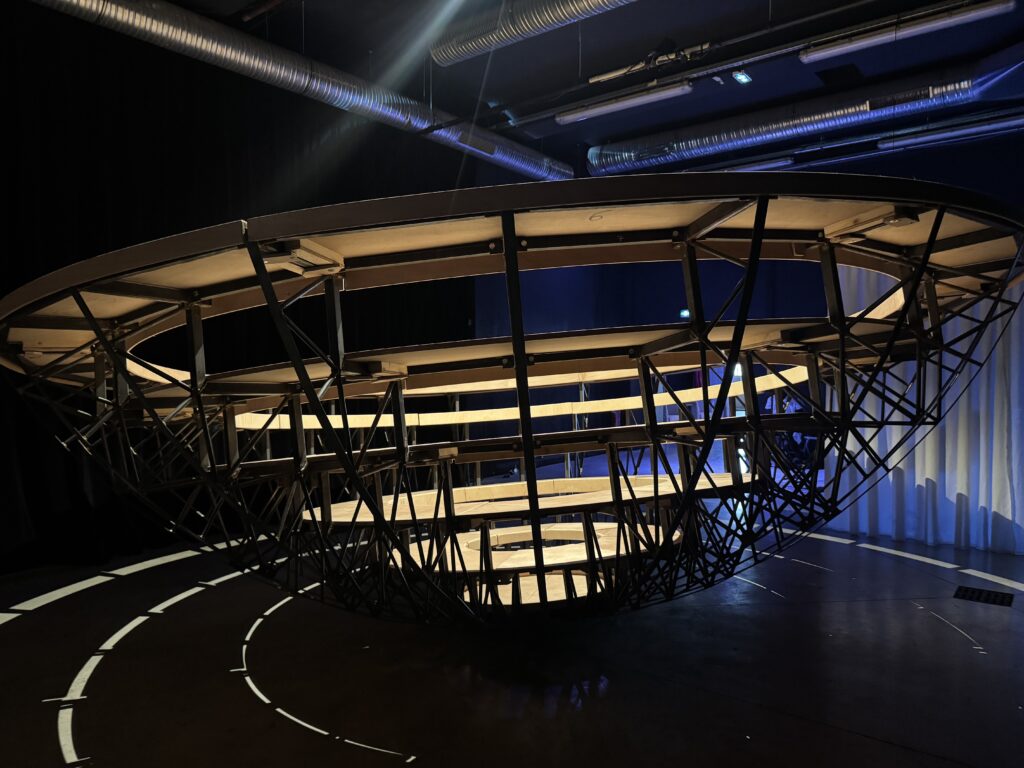
The same artist proposes Human Beeing, a virtual reality installation that mixes sculpture and botanical imagery, inviting us to rethink the position of the human being within biodiversity. The goal is to suggest a transition from a passive and destructive attitude to a more conscious and participatory presence.
In Corps Raccord, by Raphaël Isdant and Chia-Chi Chang, the relationship between technology and human connection is explored through a two-person experience. Visitors stand before two gongs connected by a virtual rope and must maintain physical contact to activate the device. The intensity of the contact is detected and gives rise to a sort of digital oracle, which returns thoughts and testimonies from the social network X. A work that links intimacy, virtual communication, and randomness.
Of particular interest is also Human Likes by Stéphane Bissières, which uses augmented reality and facial recognition to create a visual network among the people present. Visitors thus become part of a collective composition, but the playful experience carries with it a more unsettling reflection on digital surveillance and the invisible collection of personal data.
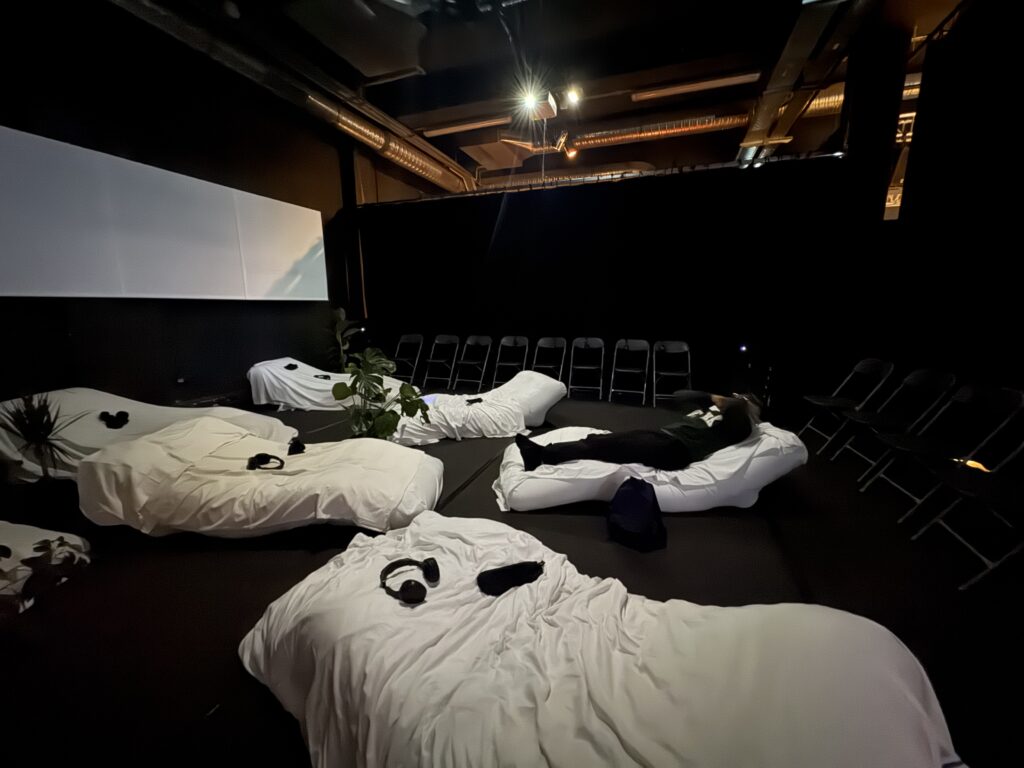
Completing the journey is Sleep for Earth, a multimedia project by the company Le Clair Obscur, conceived by Frédéric Deslias. Its provocation is as simple as it is radical: what if, to allow the Earth to regenerate, it were necessary to put humanity on pause for two hundred years? A science-fiction hypothesis that transforms into a reflection on our environmental impact and the possibility of imagining a different future.
Villa Les Palmiers: when memory meets the present
ARCHIVES NICE CÔTE D’AZUR · SACHA REY · ÉTAT DES LIEUX DES FORCES EN PRÉSENCE
The final stop of our journey leads us to a truly unique place: the Villa Les Palmiers, also known as Palais de Marbre, a splendid historic residence that has hosted the Archives Nice Côte d’Azur since 1963.
The building, with its monumental marble staircase and rooms with gilded boiseries, preserves the historical memory of the city and its region through documentary funds dating back as far as the 13th century. A place where the past is preserved, studied, and returned to the community.
It is precisely in this context that the installation by Sacha Rey, État des lieux des forces en présence, fits in—a video-documentary project that finds a very significant resonance in the particular identity of the building.
The artist starts from a personal experience. In 2021, during a trip to the Camargue with three friends, she began filming pink flamingos, observing their behavior and especially the group dynamics, tensions, and conflicts that manifest within the colony. In parallel, seven years of friendship between the protagonists of the trip ended due to political and activist divergences.
From this coincidence, a question is born that becomes the thread of the entire work: how is it possible to continue living and acting together when our ideas and positions diverge? How is a community built and preserved?
The project thus takes the form of a singular journey through the wetlands of the Mediterranean. From Barcelona to the Ebro delta, up to the Camargue, some trans-feminist and ecologist activists meet the pink flamingos, sharing experiences, reflections, and testimonies about their own battles. The behavior of the birds becomes a key to questioning human relations, forms of solidarity, and the ability to build alliances.
[metaslider id=”38957″]
But it is also the way in which the work is presented that makes this installation particularly interesting. We are not facing a simple cinematic projection. The images, distributed in space, dialogue with a sound system composed of 32 speakers, a true acousmonium that allows for the creation of an acoustic geography and the orientation of the visitor’s listening.
The choice of Villa Les Palmiers acquires, in this sense, an additional value. In a place dedicated to the preservation of historical memory, the artist proposes a reflection on contemporary collective memory, on the struggles that traverse society, and on the forms of solidarity that can arise even between apparently distant worlds. It is perhaps this dialogue between past and present, between memory and transformation, between nature and culture, that makes this stop one of the most significant of the Nice circuit of OVNi.
An invitation to look beyond the image
The three stops visited tell the story of the richness of this edition of OVNi. From the historical and artistic research on the body in the Grande Halle, to the technological experimentations of Artifice Numérique, up to Sacha Rey’s immersive installation in the Archives spaces, a common thread emerges: the image becomes a tool to question reality, challenge our perceptive habits, and imagine new ways of relating to others and the world.
OVNi thus offers a precious opportunity to approach forms of art that we often encounter little in traditional exhibition circuits. And it does so through a journey that invites you to discover Nice from unusual perspectives, entering familiar or historical places with a completely new gaze.
The Biennale will continue until December 14, with exhibitions, meetings, screenings, and events distributed between Nice and the Côte d’Azur. A month to let yourself be surprised by a festival that makes curiosity, experimentation, and freedom of sight its distinguishing feature.
Information for organizing visits is available on the official website: OVNi – Biennale 2026.
Follow AM 1575 News on Facebook for the daily bulletin from France, the Riviera and Monaco.
Fonte: Francia24 – Radio Nizza
